And We’re Off! Detox Day 1 with Green Apple Juice Video

Here we go! I feel great already, how about you?

So, yes, I (too) ate a big fat peanut butter sandwich last night on some thick, thick bread. It was DIVINE, but now that that’s over, let’s get ’em!

To start out Day 1, here’s a quick video of the Green-Apple Juice in a juicer (ignore my 6-year-old daughter who thinks she’s Inspector Gadget). I do prefer this concoction juiced vs. blended, but blending is perfectly wonderful too. If you’re blending and you don’t have a high-power blender like a Vitamix or a Blendtec, the first thing you need to do is put one of those on your 2012 holiday wish list. Or, perhaps you need to think about rewarding yourself at the end of this Detox with one of those. The next thing you need to do is if you don’t think your blender can handle the raw apple and leafies even with the 4-8 ounces of water and ice, consider using a food processor for the veggies and apples, and then blending that concoction with the water and ice. It can’t hurt.

Juice vs. Blend? Check this quick info by my pal Kris Carr of Crazy Sexy Life. She talks chlorophyll and alkalinity–it’s worth a read. And as for types of juicers, I was given the Jack Lalanne Classic Juicer as a brand new hand-me-down, and I really like it. It runs about $100 if you buy it from their website. Just an FYI. Please feel free to share juicing/juicer/blender/blending tips if you have them. As another FYI, I use my Vitamix daily (smoothies, soups, hummus, dips, etc.–I even got rid of my food processor!), and my juicer once or twice a week. Not saying that’s what everyone should do, but just facts on one nutrition professional’s appliance usage.

Still feeling good? Hungry? This day is by far the hardest, but you can TOTALLY do this. Don’t forget, however, that you can increase your serving sizes of Detox food if you’re feeling like you’re really low on calories. Add fresh fruit, raw nuts and seeds, or an avocado for quick, extra energy.

Good luck today! Please don’t forget to laugh, taste and savor every morsel and sip, and let us know how you’re doing — use the Comments section to share and question! XOXO

Cow-less Milk

Photo by: Tasty Yummies

Milk alternatives are on the up and up, and with them, our health. Here is a cool rundown of the main milk alternatives (almond, coconut, hemp, rice, and soy) and their pros and cons by dietitian Eliza Zied.

Personally, I like protein-rich unsweetened soy milk in my cereal and vanilla almond milk in my latte, and my kids down vanilla and chocolate versions of both like they’re going out of style. As for “too much soy”, up to 25 grams a day of soy protein is incredibly heart-healthy and wildly cancer-preventative. One cup of soymilk has 7 grams of soy protein. And if you’re wanting to replace buttermilk in a recipe, you must mix 1 cup soymilk with 1 Tbsp lemon juice until it curdles. Since protein is necessary for the desired curdling, it won’t happen with the lower protein milk alternatives.

While slightly harder to find (go to a health food store or Whole Foods Market), other great dairy alternatives include oat milk and hazelnut milk as well as multigrain milks. Oat milk is higher in calories (130 per cup of the Original variety), but moderate in protein (4 grams per cup) and fiber (2 grams per cup), and higher in sugar (19 grams per cup of the Original variety). Hazelnut milk has 110 calories, 2 grams protein, and 14 grams sugar per cup of the Original variety. And if you’re feeling extra daring, you can make your own non-dairy milks, which is far easier than trying to make your own dairy milk. Here’s a great step-by-step for homemade almond milk. Cheers to health and cheers to life!

Other whens and hows with dairy alternatives?

Sundowner Smoothie: A Sweet Way to Wind Down

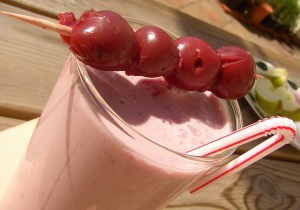
If we’ve crossed paths over the past few weeks, you’ve no doubt heard my spiel about how great tart cherry juice is for promoting restful sleep. (Aside from chocolate, sleep is the answer to most of life’s troubles.). So tonight I attempted a tart cherry smoothie nightcap of sorts to neutralize the tart in the juice. This one includes soymilk which is also naturally rich in the sleepytime amino acid tryptophan. Heck, you might want to sip it in bed in case you dose off midway through.

Photo by: kochtopf

Sundowner Smoothie
Serves 1 Wired Individual

4 oz tart cherry juice
4 oz unsweetened soymilk
1 organic orange, peeled
1/4 tsp vanilla extract
4 ice cubes

Blend until smooth. Tastier than chamomile tea for sure!

Nutrition info per sleepyhead: 172 calories, 2 g fat, 60 mg sodium, 33 g carbohydrates, 3.5 g fiber, 18 g sugar, 4.5 g protein, 8% vitamin A, 117% vitamin C, 20% calcium (200 mg), 3% iron. 

Are you asleep yet?

Regular Chocolate Consumption Lowers Heart Disease Risk by One-Third

Photo by: loririce

Thank heavens we made a chocolate glaze for our donuts this weekend! A new meta-analysis in the British Medical Journal concluded that after analyzing the chocolate eating habits of over 100,000 peeps, the highest consumers (exact quantity too hard to measure) had a 37% lower risk of cardiovascular disease, 31% lower risk of diabetes, and a 29% lower risk of stroke. Being that most chocolaty foods are also rich in artery-clogging saturated fat and cholesterol, it’s important to choose dark chocolate, and small quantities each day. Such As:  a few squares of Trader Joe’s Dark Chocolate Truffle bar, or any of the low-fat, low-cholesterol chocolate delights posted here.

The reason for chocolate’s ability to guard and protect the heart is it’s high concentration of polyphenols, which are powerful antioxidants and anti-inflammatory agents. However, beans and veggies are also rich sources of these almighty stewards. So, sounds like a diet rich in veggies topped off with some dark chocolate each day is a perfect plan!

More details in today’s USA Today.

Purple Grapes Lower Heart Disease Risk

Photo by: Noel Zia Lee

If you didn’t hear it during your morning commute this AM, a cup a day of purple grapes may lower your heart disease risk. Finally, something to eat MORE of to help your super muscle! Even more details on the hows & whys here.

What else do you do to take care of your heart?

Garam Masala: Making Beans UnBoring for 800 Years!

Photo by: FotoosVanRobin

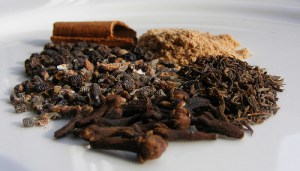
I finally realized why my kitchen-made Indian food was tiers below the smooth grub at Bombay Gaylord: the absence of Garam Masala. It didn’t matter if I used gallons of coconut milk or bags of curry powder, without the hard-to-find GM spice mix, you might as well forget it. Garam Masala has 5 A’s!, and is a blend of cumin, coriander, cinnamon, cardamom, black pepper, and sometimes nutmeg. It’s been used since the 13th century in North Indian cuisine. The mix includes spices that help boost brain function and decrease inflammation (cinnamon), control blood sugars (cinnamon & coriander), fight cancer and ease digestion (cumin), and lower cholesterol (coriander). And it makes beans and other less appealing veggies taste exotic and exquisite.

I had a touch of trouble finding Garam Masala, but finally had success at my local food co-op (because eventhough you can make it from scratch, I wasn’t about to sacrifice a bike ride or a shower to do so), and had a chance to put it to the test.

We had just walked in the door from vacation and were in desperate need of groceries. Do you have the energy to zoom to the grocery store after stepping off an airplane? Me either. So I scrounged through the cupboards, freezer, and fridge, and salvaged portions of our garden produce that hadn’t been tasted by the squirrels, and ended up with a total hit of a dinner:

No-Food-in-the-House Curry
Serves 6

2 tsp olive oil
1 on-the-verge onion, shady spots removed, remainder diced
2 tsp crushed garlic (in the squeeze tube)
1 tsp curry powder
3 tsp garam masala
1 tsp sea salt
2 cups dried red lentils (could be any color lentil)
3 cups filtered water
4 ripe tomatoes (actually used the untouched portions of 6)
7 stalks organic celery (who says organic goes bad fast in the fridge?)
1 cup frozen organic chopped spinach
1/2 can (about 7 oz) light coconut milk
4 cups cooked brown rice (cooked while veggies & lentils cooked)

In a large pot, sauté onion, garlic, spices, and salt in olive oil until onion starts to brown, about 3 minutes.

Add remaining ingredients (minus the rice) and bring to a boil. Reduce heat to simmer, cover, and cook until lentils and veggies are tender, about 20 minutes.

Serve over brown rice.

What the critics said:
Bitchin’ Dietitian: “Hot Damn!!”
Bitchin’ Husband: “Wow. There’s a hot kick, and I think this is the best thing you’ve ever made.”
5-Year-Old: “I love it. Especially the rice.”
3-Year-Old: “I’m eating it, aren’t I? But now my tummy’s full.”
1-Year-Old: “…..” (Silence as he scarfed down an entire bowl.)

A healthy hit!! Your best “No-Food-in-the-House” meals?

Gluten-Free and Fabulous

It seems like no matter where I am… grocery store, nutrition counseling clinic, REI, playground… I find myself recommending a gluten-free 10-day experiment to folks who are feeling zapped on energy, gassy, irritable, unable to focus, and unexplainably bummed out. So, despite feeling fantastic, focused, and strangely excited by everyday chores, I decided to do, track, and share my own dietitian-approved gluten-free day.

Gluten–which is the Latin word for “glue” (tasty!)–is the protein portion of a wheat kernel, and important in giving wheat flour it’s elasticity. You may have heard of Seitan, aka the “wheat meat”, which is pure wheat gluten, and pure protein. Gluten, unfortunately, is responsible for a whole variety of allergies ranging from very mild and often unnoticeable to extremely painful, disruptive, and seriously serious (such is the case with Celiac disease). Gluten also tends to cause inflammation, and while I’m personally quite a fan of the glue myself, it’s amazing how great people feel after ditching it for 10+ days. Here’s how my gluten-free day tasted:

Breakfast
Gigantic glass of water, 2 cups coffee with soy creamer & sugar
1 slice of DELICIOUS Udi’s Gluten-Free Whole Grain Bread (Know of any good egg-free, gluten-free breads?)
Hot cereal made with 1 cup cooked quinoa, raisins, chopped apple, vanilla soymilk, and cinnamon

AM Snack
Water
1 Trader Joe’s FIBERFUL fruit bar
1 plum

Lunch
Water
1 cup baby carrots
Large arugula salad with 3 pieces of homemade baked tofu (recipe in upcoming Trader Joe’s Skinny Dish! book)
2 gluten-free Sesame Cherry Chewies (again in the upcoming Trader Joe’s Skinny Dish! book)
Rice crackers
2 small squares dark chocolate

PM Snack
Water
Apple
Trader Joe’s Roasted Seaweed Snack (whole package)
1/2 Haas avocado w/ sea salt (HEAVENLY!)

Dinner
Water (skipping the Hefeweizen, but could opt for a gluten-free beer)
2 corn tortillas with vegetarian refried beans and loads of stir-fried bell peppers

Late-Night Snack
Water
1 slice Udi’s Gluten-Free Whole Grain Bread with peanut butter and sliced banana
Chamomile tea

What I Wanted to Eat But Had to Pass Up…
The kids’ leftover cinnamon raisin toast at breakfast, pretzel sticks, graham crackers, a whole grain tortilla, and a whoopie pie.

If you have the right ingredients on hand, this is totally doable, tasty, and energizing! Other glue-free ideas?

Anti-Inflammatory Foods: Extinguishing A Chronic Inner Campfire

Motivated by a recent knee injury (after diving for a frisbee without a cape), I’ve decided to revisit inflammatory and anti-inflammatory foods.

Back in 2004, before iPads, Time Magazine published an article blaming inflammation for heart attacks, cancer, Alzheimer’s, you name it. So what IS inflammation and how does it do good or evil? I always liked a good campfire. Should I not?

Here’s the deal: During an injury, blood vessels widen (swell) to allow white blood cells to rush to the injured area, repair damage, and wipe out bacteria. This swelling/ inflammation/ “healing” process is what actually causes the pain of an injury, and it’s one of our body’s best defense systems. This is acute inflammation (Funny, because my knee is far from cute!).

 
Now. Injury aside, there are also lots of pro-inflammatory troublemakers that are continuously released in our bloodstream. They’re killer whales that attack healthy cells, blood vessels, and tissues rather than protecting them. And while we can’t live without acute inflammation, this chronic inflammation can wreak havoc over time (like a slow poison), and it rears it’s not-so-purdy head with type 2 diabetes, rheumatoid arthritis, arterial plaque buildup, heart disease, stroke, colon cancer, digestive disorders such as Crohn’s and ulcerative colitis, neurological diseases such as Alzheimer’s and dementia, allergies, migraines, and fibromyalgia.

Whether your goal is to decrease joint pain, digestive upset, plaque formation, or prevent cancer, here are inflammatory foods to keep to a minimum:

 
Inflammatory Foods to Avoid (more details here)

  • Sugar
  • Common Cooking Oils
  • Refined Grains (white bread, white rice, white pasta, cakes, cookies, etc.)
  • Dairy products
  • Meats
  • Trigger Foods that exacerbate symptoms (many people are sensitive to wheat gluten, corn, and eggs)
  • Alcohol
  • Food Additives
  • Trans Fats

Certain people and certain diseases may be more sensitive to certain foods.  Wheat and dairy tend to be especially common triggers for Crohn’s disease, and meat and alcohol for ulcerative colitis.

People who are chronically stressed maintain a low-grade level of inflammation. So even when food isn’t triggering the inflammation, the body has a harder time fighting illness and disease. Inflammation can be reduced by (obviously) avoiding trigger foods and inflammatory foods, and keeping portion sizes small at mealtime. Overeating also encourages inflammation. A plant-based plan not only avoids the major inflammation triggers, but is especially low in calories, and even includes many of the foods helpful at reducing inflammation.

Anti-Inflammatory Foods to Gulp Down (more details here)

  • Tart cherries, blueberries, raspberries, and lots of other lip-smacking fruits
  • Avocados
  • Sweet Potatoes
  • Broccoli, and most green and aromatic veggies like onions and garlic
  • Herbs & Spices: Basil, Cayenne Pepper, Chili Pepper, Cinnamon, Cloves, Mint, Oregano, Parsley, Rosemary, Thyme, Turmeric
  • Cocoa (70% or more) and Licorice
  • Fermented foods (tempeh, miso, etc.)
  • Almonds, Walnuts, Hazelnuts, Sunflower Seeds, Flaxseeds
  • Plant sources of omega-3 fatty acids such as hemp oil and flax oil
How to incorporate these foods? Check out these recipes!