The Fatten-Up-My-Jake Shake

The Fatten-Up-My-Jake Shake

Many of the discussions on this site are about eating tons of plant matter so you can strut a hot, steamy bod in spandex without ever having to diet, and finding ways to make and crave nutrient-rich veggies like a wild tiger. And while those are the interests of most readers, there are a few who are trying to put weight on, definitely not take weight off, and others trying to input enough calorie-rich plant foods to meet marathon and triathlon training needs. This post is for that group.

The youngest resident Chez Bitchin’ (Jake) is 20 months old and loves fruits and veggies SO MUCH that he eats them first at meals, quickly declares “ah da” (all done), and is ready to run off and play. At his last check-up, the pediatrician (a no-doubt bitchin’ pediatrician!) expressed concern that he had only gained 1.5 lbs in 6 months and had dropped from the 50th to the 15th percentile for weight. His height and head were above average, he just wasn’t getting fat enough fast enough. It’s a dietitian’s dream and nightmare all rolled into one! He’s eating more fruits and veggies than the average American and is developing an awesome palate, but is too thin.

Side Note: My other 2 kids also love fruits and veggies, but they inhale their whole grains and proteins like nobody’s business, and have always been way above the growth curve. Up until now, it was no surprise that my kids were superhero health hounds. I was a perfect dietitian mom! But shoot. Wake-up-call with kid #3.

SO, inspired by Kathy Patalsky’s Easy Energy Almond Shake, I created a new Jake staple called The Fatten-Up-My-Jake Shake. Not only is it a great way to get some high-qual protein and nutrients into your veggie- and fruit-enthusiast kid, but it’s a stellar pre- and post-workout shake, and a great way to start anyone’s day. And the extra bonus? While it’s working to beef up my little toddler monster, it’s not so high-calorie that it’s anything beyond a nutritious drink for a weight-loss hungry soul (Read: It won’t fatten you up if you’re not trying to fatten up). Just work it in with all those lip-smacking veggies, and it won’t do what you don’t want it to do.

Jake enjoying his shake

The Fatten-Up-My-Jake Shake
Serves 3

2 cups vanilla soymilk (or other non-dairy milk + 1/2 tsp vanilla)
2 frozen very ripe bananas, sliced prior to freezing, or carefully after freezing
3 Tbsp almond butter (I like the creamy w/ sea salt variety)
1/2 tsp cinnamon
1/8 tsp almond extract (which we just learned is made from fruit pits)
6 ice cubes

Blend ingredients until smooth. Drink and conquer!

Nutrition Info Per Serving (about 1 cup): 242 calories, 12 g fat, 0 mg cholesterol, 66 mg sodium, 28.5 g carbohydrates, 3 g fiber, 14.5 g sugar, 7 g protein, 8% calcium, 12% vitamin C, 25% calcium, 9% iron.

As you can see, Jake’s pretty thrilled with the shake, so I’ll let you know what happens at his next weigh-in.

Other ideas for getting healthy, calorie-dense foods (beyond avocados and peanut butter spoons…)?


Nut Allergies: Why the Rise, and Can They Be Prevented?

Allergy-Free Seedy Energy Bars in SkinnyDish!

Happy Saturday! Now let’s talk about nut allergies. Seems like every other kid these days is allergic to peanuts and/or tree nuts. How come only that one crazy kid with the perma bed-head had a peanut allergy when I went to elementary school? Lets first start with some definitions:

  • Tree Nuts: almondscashews, filberts/hazelnutsmacadamia nutspecansBrazil nutspine nuts (pignolia nuts), pistachios, and walnuts.
  • Peanuts: Peanuts are actually a legume, although most people who are allergic to tree nuts are also allergic to peanuts and vice versa.
  • Seeds: While sesame seeds are common and potential allergens, sunflower and pumpkin seeds very rarely cause an allergic reaction. Use sunflower seed butter and pumpkin seeds as nutritious alternatives when tree nut, peanut, or sesame seed allergies are present.

Why are nut allergies so common now?
According to WebMD, Peanut allergies more than tripled from 1997 to 2008:

  • o.6% of kids had allergies to peanuts in 1997
  • 2.1% of kids had allergies to peanuts in 2008
  • 1.3% of adults today have peanut allergies

Theory #1: The Hygiene Hypothesis
Perhaps too much hand sanitizer, too many antibiotics, and all the “clean living” which is preventing natural infections is dumbing down our immune systems, and diminishing its ability to deal with harmless proteins like those in peanuts, tree nuts, animal dander, and pollen.

So… do kids who grow up on farms have fewer allergies? Actually yes! Believe it or not, city living is much cleaner than farm life. Youngsters who grow up on farms are 30-50% less likely to develop allergies and asthma compared their urban cousins. Despite city pollution and grime, rural households have more “good germs” found in bacteria-laden mattresses and microbe-laced bedrooms helping kids develop resistance to allergies and asthma. Much of this was confirmed in a study in the New England Journal of Medicine published in February comparing bacteria and microbes in rural, urban, and suburban households. The greater the number of microbes (farmhouse), the lower the incidence of allergies and asthma.

Theory #2: The Modern Way Nuts Are Processed
Most nuts these days are roasted. Back in the day, blanching, boiling, and raw consumption of nuts was more common. Dry-roasting at high temperatures appears to degrade the carcinogenic aflatoxins found in peanuts, which is something we DO want to do. However, roasting peanuts changes the sugar and makes the protein more stable to digestion, and easier for the immune system to attack thus making them more allergenic. Interestingly, Asians predominantly eat boiled peanuts, and peanut allergies are much less common among Asian populations.

Are nut and other allergies preventable?
Possibly. Here are the best strategies for decreasing the odds of allergies in your mini-me, especially if allergies run in the family:

  • Consider a move to a rural area during pregnancy and the early years of your child’s life.
  • Snag a dander-laden pet or two during pregnancy and your baby’s infancy (if you yourself aren’t allergic).
  • Spend lots of time outdoors during your child’s early years, exposing them to a wealth of trees, grass, bushes, and flowers.
  • As a mom, do everything in your power to breastfeed or obtain breastmilk from a donor, especially for the first 4 months. This builds up the infant’s immune system.
  • If nut allergies run in the family, research is tending to favor moderate and RAW nut consumption during pregnancy. There’s no guarantee, but this is worth a shot.
  • And this just in!! Pregnant women consuming greater quantities of omega-3 fatty acids (found in walnuts, flaxseed oil, and supplements) cause the growing baby’s gut to become more permeable therefore enabling bacteria and new substances to pass through the lining of the gut and triggering the baby’s immune response and the production of antibodies. End result: a better functioning immune system and less likelihood of allergies.

And finally, and interesting tidbit about…. Almond Extract. Thankfully, the best way to flavor your cookies and frosting does not actually come from almonds. Even “pure almond extract” is made from peach or apricot pits. So almond-allergic folks can taste almonds without the allergic reaction!

Other thoughts on nut allergies or ways to prevent/ deal with them?

Back to School: Bag Lunches for a Dietitian’s Kindergartner

Photo by: Ramesh NG

I have *just about* survived Week #1 of Kindergarten! My daughter is in an all-day Spanish immersion school, so not only are the all-day routines and riding the bus completely new experiences, but the whole day is in Spanish. And that’s not even the biggest deal! Eating lunch in a school cafeteria is a totally brand spankin’ new event.

Of course as the nutrition controller of the household, buying lunch at school isn’t an option despite the constant begging… “Just one day could I try the cheesy sticks, mini pizza, or milk in a cute pink carton? Pleeeeeze?”  So it took some creativity and dessert! to make the bagged lunches exciting, tasty, and healthy. Here’s what appeared in my daughter’s lunch bag this week:

MONDAY
Half a hummus and basil sandwich on whole wheat bread

1 large carrot, peeled (she prefers 1 large carrot to carrot sticks, not my idea!)
8 raspberries
6 crackers
2 chocolate-filled Oreo-type cookies
water

What still remained in the lunch bag after school: the carrot (“I didn’t see it”), crackers, and cookies. Those items became the afterschool snack. 

TUESDAY
Half a peanut butter sandwich on whole wheat bread (no jam, her preference)

Apple Carrot Crusher (from TJ’s, basically applesauce with carrots in this fun squeezy tube)
8 raspberries
5 slices orange bell pepper
6 crackers
2 chocolate-filled Oreo-type cookies
water

What still remained in the lunch bag after school: the raspberries (“I couldn’t open the container, and no one was around to help me”), crackers, and cookies. Those items were again the afterschool snack. “Mommy, you don’t need to put crackers in my lunch anymore.” Ok, I won’t!

WEDNESDAY
3 Spinach & Sweet Potato “Quiches” (eggless, made in a mini-cupcake pan, recipe coming soon!)

10 Beef-Less Strips (TJ’s, made from wheat gluten)
10 cucumber slices
Apple Carrot Crusher 
2 chocolate-filled Oreo-type cookies
water

What still remained in the lunch bag after school: 2 of the “quiches,” 3 cucumber slices, and cookies. Those items were again the afterschool snack.

THURSDAY
1 Smart Dog in a whole wheat bun (wrapped in foil, no condiments, her choice)

Apple Carrot Crusher 
4 cherry tomatoes, 4 basil leaves
2 Medjool dates
2 chocolate-filled Oreo-type cookies
water

What still remained in the lunch bag after school: dates and cookies. Afterschool snacktime!

FRIDAY
Half a chocolate peanut butter sandwich (sounds terribly unhealthy, but it’s just peanuts + a few dark choc chips ground together fresh at Whole Foods) on whole wheat bread

6 red pepper slices
10 Kalamata olives
1 chocolate chip cookie
water

Not sure what will return home today, but I suspect a couple red pepper slices and the cookie. 

You may think the daily dessert isn’t ideal, but growing up in a “Dessert-Only-Once-A-Year” household, I firmly believe that a small dessert after a nutrient-rich meal teaches healthy eating habits and moderation. Agree or disagree? For more healthy lunchbox ideas, take a gander at The Lunchbox Bunch: A team dedicated to healthy lunches!

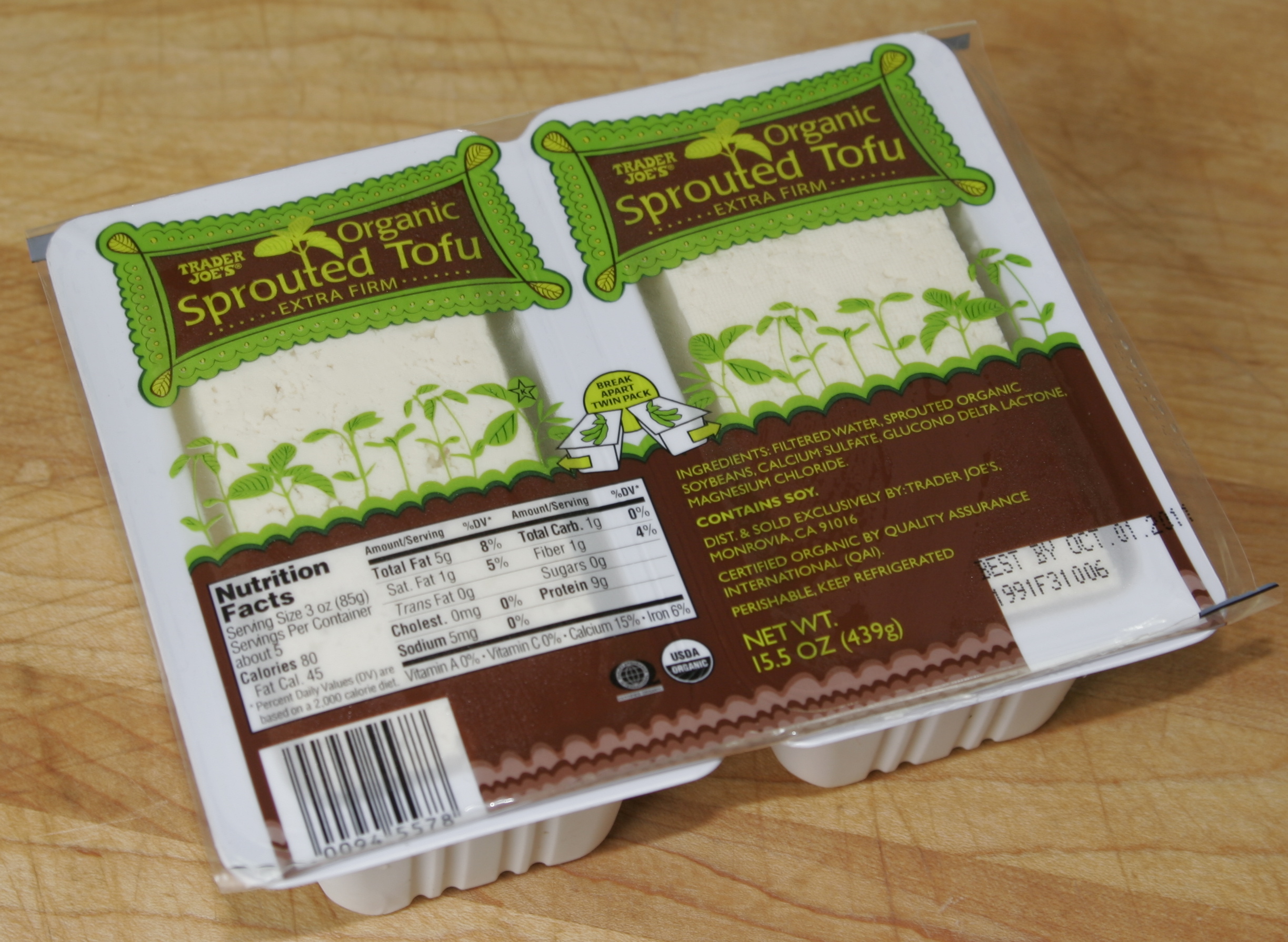
Product Review: Trader Joe’s Sprouted Tofu

Why Sprouted? (we’re beyond ‘Why Tofu?’, right?!) Regular tofu is made from cooked soybeans while sprouted tofu is made from sprouted soybeans. Sprouted tofu is easier to digest (sprouting softens the beans and releases troublesome phytates), and is richer in protein, calcium, and iron. Too good to be true? Nope! Sprouted T is similar in calories, slightly lower in carbohydrates, and slightly higher in fat (but the good omega-3 fish-oil type).

Getting soy foods into your cauldron is a pretty good idea. They help lower blood pressure and cholesterol, especially the bad, garbage-on-the-curb-of-your-arteries LDL kind, while also curbing diabetes and preventing cancer and its recurrence.

Sprouted tofu is used just like regular tofu (in Chocolate Mousse, or any of these 200 recipes), but what about the taste? Sponge-tastic? I surveyed Team Reilly in comparison to Trader Joe’s organic regular extra firm tofu (which is a family favorite). Both tofus were uncooked and untouched.

During a blind taste-test, I asked the team which one they preferred and if they could tell which one was sprouted.

Results:
Bitchin’ Dietitian: Preferred the softer-textured sprouted tofu, and of course knew it was the sprouted tofu b/c she made up the test.
Bitchin’ Husband:  Thought the regular tofu had more flavor, and that the sprouted tofu wasn’t bad, but tasted like nothing. Guessed that the one he preferred was the sprouted tofu, but it was actually the regular tofu.
5-Year-Old: MUCH preferred the sprouted tofu and ate more than her taste-test serving, but thought it was the regular one.
3-Year-Old: MUCH preferred the regular tofu and ate more than his taste-test serving, but thought it was the sprouted one.
1-Year-Old: Didn’t have a preference, and ate both quite vigorously. When asked which one he thought was the sprouted one, he said “eh eh eh.” Translation:  “the one on the left” (the sprouted one).

Interpretation of Results:
Sprouted tofu–with its easier digestion, higher levels of protein, calcium, iron, and omega-3 fats–is a groovy alternative to regular tofu. Since few people eat tofu raw (thank your lucky stars you weren’t part of today’s test), stir-frying, and adding flavors to tofu will change both types similarly. Sounds like a Sprout-Out for TJ’s Sprouted Tofu!

Recipe op?… What are your favorite ways to do tofu, or, now, sprouted tofu?

St. Patty’s Day Week: Green Food #2: Green Smoothies (of course!)


You had to see this one coming! If green smoothies mean St. Patrick’s Day, then the Reilly family celebrates most days. Check out the recipe in the picky kids post. And, feedback welcome on my new food photography hobby, which I’ve started as a result of my upcoming Trader Joe’s cookbook. Happy Green Drinking!

And the Winner is… Popeye!


Photo by: Norwichnuts

 In an effort to rename the Shrek Smoothie, I called on the creative masses in a bitchin’ competition. Every one of the entries was scrumptious, but the grand prize goes to Sir William Hesselton of Virginia. From here on out, we’ll be referring to the green spinach-laden smoothie as the “Popeye Smoothie” (Popeye Smooth-Eye!), or in back alleys as simply “The Popeye.” Our pipe-smoking buddy (we’ll talk smoking cessation later) got strong with the green leafy, and who doesn’t want to get strong? Kids, adults, and even kid-at-heart adults. Way to go, Will!

Don’t be sad if you’re not Will… keep in mind that if you’ve got a favorite name for the drink, there’s no reason why you can’t call it whatever excites you to drink it more often: Puce Juice, Shamrock Smoothie, Spanikolada, Four-Leaf Cocktail, Greenhouse, Shrekoothie, Jade Smoothie, Emerald Smoothie, Emerald Forest, Spartan Smoothie, Green-Tini, or Shrek on the Beach. Drink up, and cheers to life enriched with green goodness!

Feeding Peter Piper, the Picky Pepper: Tip #3

Your kids have now had 3 servings of veggies without even knowing it… the Popeye smoothie, zucchini pancakes and carrot cupcakes. So now it’s time to make sure they haven’t filled up too much before dinner. Tip #3:

Sayonara Snacktime! Make sure your kids are really hungry come mealtime. If they pounded Cheez-Its and lemonade at 4 PM, chances are that the broccoli casserole at dinner is going to look extra gross. Kids should go at least 3 hours between meals. The exception is if the previous meal was barely touched. In this case, avoid low blood sugar rages by offering a small snack a couple hours before the next meal. My rule is that a snack has to be an item i’d be happy with as part of a meal. Do Cheez-Its go with broccoli casserole? Right. And going even above & beyond, try to make the snack something of vegetable matter. When the heads start banging the walls, here are the snacks I offer:

  • Steamed, chilled carrot coins. Dipped in hummus for an extra punch.
  • Just Peas. They taste like popcorn, but they’re dried peas. I ate these before having kids, I swear.
  • Veggie Booty. Robert’s American Gourmet makes other yummy snacks, but these have powdered spinach, broccoli, kale, carrot, cabbage, and parsley. If your kids don’t like those veggies in whole form, they’ll no doubt rejoice in their powdered byproducts. Especially when they taste like cheese doodles.
  • Nuts
  • Whole, and dried fruit (dried mango goes over especially well in our house & is full of beta-carotene)
  • Raw veggies (cherry tomatoes are a hit)
  • Beans. Drained & rinsed, straight out of the can.
  • Edamame. Fun to pop out of the pods, and easy to pop in those cute little mouths.

While there are certainly even more ways to get healthy foods into your kids, including scare tactics, cookie cutters, and toothpicks, we’ll leave it at these 3 tips for now. Please share your successes, ideas, and requests for further tips in the Comments section. Happy eating!

Feeding Peter Piper, the Picky Pepper: Tip #2

How was that smoothie this morning? Sounds like you’re ready for finicky kid Tip #2:

Shred or purée veggies and put them in everything. Pasta sauce, pizza sauce, pancakes, banana bread, cupcakes, even cookies. The idea here is that they’ll get the nutrients from the veggies and their bodies will learn to love them through deception, inception, and misconception. The best veggies to sneak in are zucchini, yellow squash, kale, spinach, and carrots. Jerry Seinfeld’s wife Jessica actually put together a book of recipes like this called Deceptively Delicious. While i haven’t actually tried any of the recipes, she’s got some great ideas to help get healthy food into your kids’ pods.

Stay tuned for tomorrow’s Tip, and share your ideas for sneaking in the good stuff!

Feeding Peter Piper, the Picky Pepper: Tip #1

Before having kids, I did countless TV and radio interviews stressing the importance of establishing healthy eating habits in childhood, and ways to get picky eaters to eat veggies, fruits, and even vegetarian freak foods like tofu and tempeh. And then i had kids of my own. My first child (a girl) was actually a breeze. Right from the start she loved broccoli, avocados, Boca burgers, tofu, and would show up empty-handed and red-mustached when asked to go pick the tomatoes from the garden. So I was right all along! Offer them only healthy things and they’ll eat only healthy things. I can’t believe CNN even bothered to cover this. It was a no-brainer!

Then my son came along. Before even introducing him to solid food, I knew I’d be in trouble. So when he refused to eat food #1–avocado–I realized I’d have to reach into my bag of tricks right away. Thankfully, he ate other fruits and vegetables, but if you tried to feed him anything he didn’t like (like pasta), he’d channel his inner gag, and that was the end of that meal. For the whole family.  “Keep trying the foods they don’t seem to enjoy. One day, things might change. Don’t give up!” Did I really say that? Exactly how many times did i recommend people do this? 7 times?

The good news is, thanks to creativity, dessert bribery, and the elimination of snacks, at the age of 2 1/2, boychild is a pretty good eater even by dietitian standards. And as for the “keep trying” part—despite the consequences—I do. We had a major breakthrough last week. After 2 years of gagging, crying, and spitting out tofu, it finally made it down the esophagus. He even said “i like that toe food!” That, my friends, is some bitchin’ determination payoff! (I haven’t gotten the nerve to try him on tofu since, but i remain optimistic!)

I suspect our 3rd babe (also a boy) will bring yet another personality to the kitchen. He’s only just now starting on solid food and seems to prefer spitting things out and wiping them in his eyelashes. So obviously this is a personal work in progress. But, over the next 3 days I’ll share tips that have gotten us through thus far. Here is Tip #1:

Start the day with a green smoothie. The kids are hungry, and thirsty. Get them started on the right foot. The green part is pre-washed raw baby spinach, which is tasteless in a smoothie. The rest is up to you… fruit (banana makes it creamy, but be warned that dark-colored fruits will make the smoothie brown), something frozen (fruit or ice), and then enough liquid (ideally fortified non-dairy milk and/or water) to reach the height of the solid foods in the blender. Blend until it’s a beautiful ogre-green color. Here’s one that totally rocks:

Popeye Smoothie
Serves 4

1 banana
3/4 cup frozen chopped mango
1/2 cup frozen chopped pineapple
1/2 cup green grapes
2 tablespoons calcium-fortified orange juice concentrate
1 1/2 cups (2 large handfuls) raw baby spinach
1 tablespoon spirulina-type green powder (e.g. “Very Green” from Trader Joe’s)
8 ounces unsweetened calcium-fortified almond milk
ice cubes for a thicker smoothie/ chilled water for a thinner smoothie

Per serving: 78 calories, 1 g fat, 0 mg cholesterol, 17.8 g carbohydrate (2.2 g fiber, 12 g sugar), 1.2 g protein, 70 mg calcium, 42% of your daily vitamin C, 29% of your daily vitamin A.

Comment with your own tips and tricks over the next 3 days… I often deplete even my own arsenal!