
Oh, NUTS!

Out-Of-Hand Nuts (and a few Seeds)

Unless you have an allergy (obvious, and more about why those are on the rise here), it’s time to pop some nuts into your mouth. A new study published in Nutrition Research concluded that even though nut enthusiasts generally have a higher overall calorie intake, 1/4-ounce or more per day of OOHN (Out-Of-Hand Nuts) meant better overall intake of healthy fats and fiber, and a lower intake of cholesterol, sodium, and sugary carbs. More OOHN also meant lower risk of high blood pressure and better “good” HDL cholesterol–both indicative of lower heart disease risk. And yes, the researchers coined the acronym for Out-Of-Hand Nuts, which literally means nuts that you eat out of your hand versus those stashed in cookies, bread, cakes, etc.

While OOHN lovers DID consume more calories than OOHN anti-lovers, the lovers generally had similar or lower Body Mass Indexes. Perhaps it’s all the calories burned tossing the nuts into one’s mouth. Have you had YOUR out-of-hand nuts today?

Skinny Dish! 7-Day Detox Testimonial

Day 1: Green Apple Juice

Guest Post by Megha Shah Even

I began the 7-Day Skinny Dish detox, along with my husband and sister-in-law, as a healthy start to the new year. My experience with other detox programs is limited: it has been a year since my last detox and with the assumption that all detoxes are alike, I was dreading this one. It turns out that my last detox stunk. This detox is AWESOME!

The first thing I noticed was how bright and vibrant all the veggies looked when I wasn’t cooking the life out of them. I could really taste each fruit/vegetable. I was sure I’d never had blueberries that tasted so good! Although the individual ingredients in each recipe were familiar to me, the combination was such a delightful surprise. Each meal was packed with flavor and I was eager to try out the following day’s recipes. There were a number of standout meals: Mango Summer Salad, Veggie Pupusas, Tofu Feta, Walnut, and Beet Salad, Curried Lentil Stew, Arugula Salad with Pan-Seared Butternut Squash. However, the real star of the show was the Fiery Cashew Dip (*drool*).

Another surprise was the realization that I’ve likely been dehydrated for over 10 years. I immediately noticed a difference with the increased water intake–my skin felt soft and aglow! I found a strange comfort in the water-pee-water-pee rhythm of my days. The shakes/juices (Green Apple Juice. YUM.) provided a nice perk in the morning and mid-afternoon tea was a great way to simulate the ritual of morning coffee. I did not feel hunger at any point during the week and found this detox to be f-u-n! I suggest asking a friend or family member to join in–it was helpful to share funny texts with my husband and sister-in-law throughout the week. The only negative for me was a moderate headache in the evening for the first four days. I blame years of caffeine addiction.

In my opinion, the 7-Day Skinny Dish detox takes a common sense approach to healthy eating. I was able to keep the party going for another week due to all the leftovers. Post detox, I have added kale to my weekly shopping list and have incorporated quite a few recipes into my weeknight meal line-up. I have continued with a high daily water intake and have increased the percentage of raw foods in my diet. I felt lighter and shed a few unwanted pounds without really trying. I enthusiastically recommend this detox to anyone who wants to jumpstart a healthy lifestyle, or is simply in need of a fresh approach to healthy eating. Word up, people! Do it! BEST. DETOX. EVER.

Megha Shah Even is a GreenSchool Educator at The New York Botanical Garden in Bronx, NY., where she leads plant science workshops for students in grades K-8. She is a compost enthusiast (loves food, hates waste) and is often spotted near grubby patches of land sneaking post-lunch organic matter into the soil. Megha is also an apprentice on a rooftop farm and currently lives in Queens with her husband, two cats, many plants, and an efficient army of red worms.

Lower Your Bad “LDL” Cholesterol in 5 Easy Steps

SKINNY DISH's "Stick With You Oatmeal"

1. Replace your eggs, bacon, or cold cereal with Stick With You Oatmeal, Baked Oatmeal, or warm oat bran (like cream of wheat, only better at lowering your cholesterol). Add fruit for extra fun. Make this a permanent change.

2. Mound half your plate at lunch and dinner with veggies. Cooked, raw, both, low-fat, and the same one every meal if that’s how you like it. Just get half your plate to be naturally colorful twice a day. The bigger plate, the better.

3. Start taking 1000 milligrams of essential Omega-3 fatty acids daily. I prefer the algae-derived kind (like this one) since that’s where the fish get it, but any will work. The Omega-3’s are extra good at improving your blood lipid levels and lowering your heart disease risk, and they make your skin as soft and smooth as a baby’s bottom!

4. Replace eggs in baking with ground flaxseed meal (like the one made by Bob’s Red Mill, found at most grocery stores). Flaxseeds are not only rich in Omega-3’s, but–like oats–they’re high in soluble fiber which does quite a doozy at lowering bad cholesterol. For each egg in a recipe, use 1 tablespoon flaxseed meal soaked in 3 tablespoons warm water for 5-10 minutes until a gel forms. Toss that gooey goodness into your recipe as you would an egg. You can also just ADD flaxseed meal to just about anything… smoothies, pancakes, oatmeal, oat bran, and soy yogurt.

5. Enjoy beans or lentils as your “meaty” entrée as often as possible. They’re exploding with soluble fiber, but they also have zero cholesterol and saturated fat–you won’t be adding any bad guys to your system, and you’re stocking up on good guys. A double win! Make it a goal of getting 1 CUP of cooked beans or lentils daily. Tips here, including ways to make them less farty.

Give these changes a solid try for 3 months, and then get your cholesterol levels tested again. I expect to hear glowing reports!

Even a Dietitian’s Child Gets Diabetes

Jake in the ER, Chowing down after his first insulin shot

Health Champs and Nutrition Superheroes,

My post today is a personal one. This past week, we found out that my 2 year-old son has type 1 diabetes (the need-insulin-shots-for-the-rest-of-his-life kind). Despite our uber healthy diet topping the charts with veggies, fruits, beans, and whole grains, an autoimmune response to a virus or reason unknown caused my littlest dude’s immune system to attack the insulin-producing cells of his pancreas. When this happens, insulin (which is like the key that unlocks cells’ doors to allow glucose to get in and do its job) can no longer be produced, leaving excessive glucose floating around the bloodstream. A normal body’s pancreas produces just enough insulin to deal with whatever carbohydrate is or isn’t eaten–no thought, shot, or pill needed. The glucose gets into the cells, blood sugars are stable, and none of it requires any extra effort.

As type 1 diabetes is hitting, however, and the insulin-producing cells are being destroyed, the body panics with the extra glucose floating around the bloodstream and reacts by pulling fluid from every store to try and eliminate the glucose through the urine. Dehydration and extreme thirst result. Those are the first signs. The next are usually lethargy and vomiting.

About 5 days before we discovered Jake’s diabetes, he had been asking for more water and urinating more. Not crazy amounts, we just had to change his diaper more often. He was getting over a cold, so of course he was thirstier. He even had a fever one night and I took him to the pediatrician first thing the following morning suspecting an ear infection. But nothing was wrong. Well, once Day 5 hit and he was still asking for “wa wa please” every several minutes (and his grandma also noticed he was cold and his skin looked a little thin), I asked the nurses at my work if they thought anything of his excessive thirst, and asked if I might borrow a glucometer to test his blood sugar levels, just to rule out diabetes. They had seen this before and were worried. They encouraged me to postpone my patients for the day and go home to test his blood sugar, and then I could return if all was well.

His blood sugar level was 560 and then retested at 549. Normal is 100-200 for a 2 year-old. Obviously, it was a faulty machine. I tested MY levels: 73. Crap. Fast-forward past the ER at Children’s hospital, IV fluids to rehydrate him, the official diabetes diagnosis, and a daylong diabetes bootcamp with a diabetes educator to learn how to test blood sugars (I was very awkward in testing his levels at home!), give insulin shots, and manage his meals. All I kept thinking was thank gosh I have the nutrition stuff down because the insulin and blood sugar monitoring was about all the new learning our brains could take!

So, here we are now on Day 3 at home and are getting used to our new ways. We’ve only now realized how much more alive Jake is compared to last week. His body is happy, he laughs and jokes constantly, he’s gained nearly 3 lbs since getting insulin shots because his cells are finally getting the glucose they need, and he’s even telling us which finger to prick for each of his glucose checks. Our days consist of 4 insulin shots, several blood sugar checks to help detect low blood sugar levels (which can be serious)–including 2 while he’s sleeping. My husband and I sneak in there like a diabetes SWAT team with our headlamps and blood sugar checking gear. Most of the time, he sleeps right through! Blood sugar checks also determine what kind of snack he can have: low-carb if his blood sugars are within the normal range, and carby if his blood sugars are low. Our days no longer include enticing desserts to encourage veggie consumption at mealtime, and there are no more meals on the run. Meals MUST be balanced: moderate carbohydrates (about 30-40 grams per meal), protein, and fat. Carbohydrates turn into glucose in the bloodstream immediately, 40% of protein turns into glucose 1-2 hours after consumption, and 10% of fat turns into glucose about 4 hours after consumption. A balanced meal means blood glucose levels are less likely to drop too low between meals. We can do this!

Thanks to our previously healthy habits, the nutrition part of diabetes management is pretty much the same, and any changes have been for the better (we WERE probably getting a little too crazy with the desserts…). Today for lunch, we all had hummus (some carb, some protein, some fat), broccoli (a “free” and healthy food), whole wheat crackers (only a few, so Jake also had a banana to meet his carbohydrate needs), avocado slices (fat), and ice water. The morning snack which would have been pretzels, became a naturally low-carb peanut butter spoon, one of Jake’s all-time favorite treats. We’re all having to change some–We, and my other 2 kids can’t be chowing on foods that Jake can’t have (like pretzels at snacktime) until Jake understands what’s going on. But we’re realizing that his diet is actually just a balanced one that leaves the junk behind. We’ll all be even healthier now!

Obviously, this new life is no walk in the park, and my anti-carb-counting and anti-low-carb days are over. I appreciate both now. But, we are so blessed to have this super cool kid, who can still be a kid and live a healthy, normal life. We’re finding that type 1 diabetes isn’t hard, it’s just more. More to watch and do. So we’ll probably just put off getting that puppy for now… 🙂

Even a dietitian’s child gets diabetes, and even a dietitian’s family can improve their eating habits. Stay tuned for a new tab: Bitchin’ Diabetes! And please share stories and tips.

Peace and balance,

xoxoxo
Jen

Baked Oatmeal: Everyone’s Doing It

Photo by: Whole Foods Market

Now that about 12 unrelated people have asked me about baked oatmeal–and 1 of them even brought me a sample (yum!)–I decided to test it out for myself.

Oatmeal in itself (even the 1 1/2-minute-in-the-microwave-old-fashioned kind) can be too time-consuming in the morning (I know, what has our busy world come to?!). And as you smarties already know, oats contain more soluble fiber than any other grain. Soluble Fiber is the champion at lowering bad LDL cholesterol. It works like this: Soluble fiber reduces the amount of bile reabsorbed in the intestines, which means more bile is excreted through bathroom activities. The liver panics and snatches LDL cholesterol out of the bloodstream to make more bile salts. Down goes your LDL cholesterol number, and your doc starts smiling again. Take home message: Eat more oats. Capiche?

Now back to the recipe at hand. This version takes about 40 minutes and can be made on a Sunday night and packaged up to be inhaled while biking, walking, or sleep-walking to work. It pretty much feels like an indulgent coffee cake. Have it for dessert!

Modified from the original version on About.com here, this one has less sugar and all the taste.

All-The-Rage Baked Oatmeal
Makes 8 servings

Prep Time: 5 minutes
Cooking Time: 40 minutes

3 Tbsp flaxseed meal (finely ground flax seeds)
1/4 cup warm filtered water
2 cups quick-cooking oats
1 cup rolled oats
1/2 cup packed brown sugar (optional)
2 tsp baking powder
1/2 tsp cinnamon
3/4 tsp salt
1/4 tsp ground ginger
1 cup unsweetened almond milk or soy milk
2 Tbsp melted Earth Balance margarine
1/2 cup fresh blueberries (preferably organic)
6 chopped fresh strawberries (preferably organic)

1. Preheat the oven to 350 F. Lightly oil an 8″ square or round baking pan.

2. In a small bowl, combine the flax meal with the warm water until the mixture forms a gel (about 5 minutes). Set aside.

3. In a medium-sized bowl, combine the quick-cooking oats, rolled oats, brown sugar, baking powder, cinnamon, salt and ginger. Set aside.  In another small mixing bowl, whisk together the almond milk and melted margarine. Add this to the dry ingredients, followed by the flax mixture. Stir until just combined. Fold in the blueberries and strawberries until evenly distributed.

4. Spread the mixture in the prepared pan and bake for 35-40 minutes, or until a toothpick inserted in the center emerges clean. Cut into 8 squares and serve warm with almond milk or soy milk.

NUTRITION INFO PER SERVING (including brown sugar): 219 calories, 6 g fat, 1.5 g saturated fat, 0 mg cholesterol, 48 g carbohydrate, 5.5 g fiber, 20 g sugar, 5.5 g protein, 1.5% vitamin A, 10.5% vitamin C, 13.5% calcium, 14% iron.

Leave the brown sugar out for an even lower sugar version. Enjoy this with herbal tea and more fruit for a high-powered way to start the day. Happy oat-ing!

Celery Root: The Unsung Vegetable Hero

Celery Root by Lee Court Farms, found on WiveswithKnives.net

Guest Post by Robyn Selman

You don’t see recipes for celery root (celeriac) very often. It’s definitely one of the ugly ducklings at the produce stand. But once you peel off that gnarly brown exterior (resembling the surface of the moon), you get a low-starch, low-calorie root vegetable that smells and tastes like a mixture of celery and parsley, and is a champion source of fiber, potassium, and cancer-fighting antioxidants. When baked until tender, the texture reminds me of cooked carrots. I always find myself turning to Mark Bittman’s cookbooks when I want to cook with a less familiar vegetable, and I was not disappointed with this recipe. Gratins with root vegetables make perfect winter meals, especially when you add beans and whole grains to make them really filling.

White Bean and Celery Root Gratin with Bulgur Crust
Adapted from Mark Bittman – How to Cook Everything Vegetarian
Serves 4

½ cup fine-grind bulgur
¼ cup extra virgin olive oil, plus more for greasing the baking dish and drizzling
1 ½ pounds celery root, peeled, and cut into 1-inch cubes (about 2 cups)
1 onion, chopped
Salt and freshly ground black pepper
2 garlic cloves, chopped
2 cans cannellini (white kidney) beans, drained but still moist, liquid reserved
1 teaspoon sweet or Spanish smoked paprika
2 teaspoons chopped fresh marjoram leaves or 1 teaspoon dried or fresh oregano
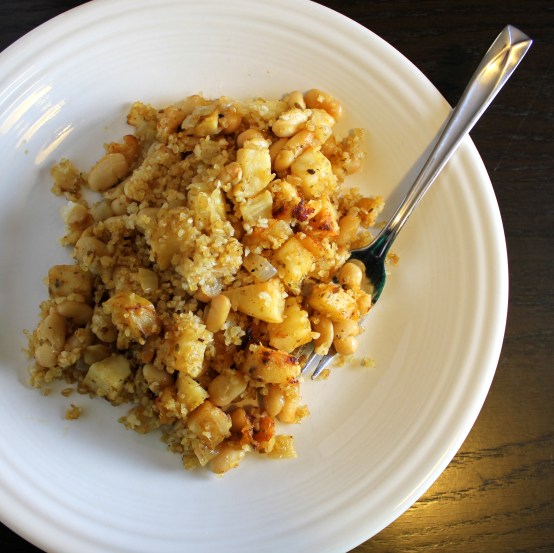
Photo by Robyn Selman

Put the bulgur into a heatproof bowl and pour 1 cup boiling water over the top. Stir, then cover with plastic wrap and let sit for 15-20 minutes. Once the water has absorbed, fluff with a fork, drizzle with a little oil, season with salt and pepper, and set aside.

Lightly oil a 2-quart soufflé dish, gratin dish, or a 9×13 inch baking pan and set aside.

Preheat oven to 400 °F.

In a large deep skillet, add 3 tablespoons of oil and heat over medium heat. When hot, add the celery root and cook for about 8 minutes, until it starts to brown. Add the onion and some salt and pepper and cook for another 3 minutes or so, until the vegetables are soft and golden brown.

Off heat, stir in the garlic, beans, paprika, and herbs. Add some of the reserved bean liquid if it seems dry (it should resemble a thick stew). Taste and season with more salt and pepper if needed.

Spread the bean and vegetable mixture into the pre-oiled pan. Top evenly with the bulgur and drizzle a little olive oil over the top. Bake for 45-55 minutes, or until the edges and top are browned and bubbling happily. The time might vary depending on how deep your baking dish is.

Serve immediately or let rest for up to an hour and serve at room temperature.

Notes:
If you can’t find finely ground bulgur at your store (I couldn’t), then you should just buy regular bulgur and grind it yourself in a coffee or spice grinder at home. The first time I made this recipe I did not grind it and I was sorry. The bulgur pieces became so hard from baking that it hurt my teeth to bite down on them. So I made it again, this time grinding it first in my small coffee grinder reserved for spices until it looked similar to fine bread crumbs, and the result was MUCH better. Just goes to show that recipe instructions are chosen for good reasons and I should really pay attention to them!

Don’t have celery root? Other vegetables you can use include: potatoes, parsnips, eggplant, cauliflower, broccoli, fennel, carrots, summer squash, green beans, asparagus, or cabbage.

Robyn Selman is a recovering “picky eater.” After eating pre-packaged, processed foods her whole life she decided to make the switch to fresh, homemade meals and has never looked back. Now she approaches cooking with the mindset of “the more vegetables, the better” and loves trying out new recipes. She tries to buy local whenever possible and loves Community Supported Agriculture. Her life happily revolves around her work, her husband, and their crazy cat. She loves board games, hiking, dancing, good books, and good coffee. You can read more on her blog, Robyn Cooks.

Soda (Part Deux): Diet vs. Regular

Izze Soda

Guest Post by Daniela Baker

If you’re addicted to drinking soda, you’re certainly not alone. Soda cans and bottles hold more than twice as much as they did in 1950, and that extra soda really adds up. With the average American drinking more than fifty gallons of soda, energy drinks, and fruity drinks a year, it’s no wonder we struggle to figure out which is the better choice.

Unfortunately, we all know that drinking soda–whether diet or regular–isn’t the greatest choice for our health. But sometimes you may feel like you need a Coke or a Pepsi to get you through the day. In times of weakness, which is the better choice: diet or regular?

Your health

According to the Harvard School of Public Health, the a single can of regular soda can run you up about 150 calories, mostly from the high fructose corn syrup used to sweeten it. Drinking just one can like this a day could help you pack on fifteen pounds over the course of a year. FIFTEEN POUNDS! Regular soda consumption boosts rates of obesity and diabetes, and regular consumption of regular soda is often a risk factor for heart disease. In Harvard’s Nurses’ Health Study, women who drank two or more servings a day of sweet drinks had about a 40% increase in their risk for heart disease related death and heart attacks.

So what about diet soda?

In the short term, the Harvard School of Public Health says that switching from regular to diet soda can help with weight loss, since diet soda doesn’t influence blood sugar levels or come with lots of added calories. However, studies have shown that consuming artificial sugars can actually cause you to consume more overall calories compared to diets that contain regular sugar and no artificial sweeteners. This is because our brains are meant to link sweet tastes and calories, and they’ll help our bodies automatically adjust intake for caloric needs. When the link between sweetness and calories is cut, though, it seems that the hormones and chemicals in the brain that tell us when to stop eating can go haywire. And don’t forget the recent study linking diet soda consumption to heart problems. Crud!

Okay, so neither regular soda nor diet soda is good for your health. But as an occasional treat, neither one of them is going to harm you too much, either. If you’re really concerned about making healthy choices, though, which one should you choose to have as a treat once in a while?

The verdict

An occasional diet soda is OK, and if you absolutely have to choose between diet and regular (meaning you’re actually going to die without one or the other, and the only options around are in a vending machine), then diet is *probably* better (Harvard says diet is better on occasion, and on account of the obesity epidemic).

HOWEVER, try to avoid getting in the “diet or regular” situation. Keep a stockpile of Izze sodas (made from sparkling juice, containing no refined sugars, preservatives, caffeine, or artificial anything) and seltzer water on hand to satisfy your bubbly needs. Or, mix seltzer with fruit wedges or fruit juice for a refreshing and actually nutritious beverage. All of these healthy options can help you wean yourself off of regular soda, and don’t add up to too many extra calories in your day. Look into the SodaStream for seltzering water at home. Save bottles, $$, and impress your friends! It costs about $100 plus the $15 carbon dioxide cartridge every 60 to 130 liters.

Daniela Baker is a health- and fitness-conscious mother of two who is passionate about overthrowing the standard American diet by teaching others how to cook healthy, home-cooked meals and trade their couch potato lifestyles for more active ones. She loves spending time outdoors with her crazy canine and two very active kids, and works hard to set a good example for her family by making healthy food and lifestyle choices. 

Bigger Breakfast = Better Life

Eggless Eggs with Whole Grain Toast, Orange Wedges, and Fruit Juice

“Breaking the fast” in a big way is perhaps the best tactic in curbing daily cravings, controlling appetite, losing weight and maintaining weight loss, and staying happy, according to a new study out of Tel Aviv. Researchers found that a 600-calorie breakfast which even included something indulgent like chocolate cake (!!) compared to a low-carb 300-calorie breakfast, was significantly more successful at helping obese individuals lose weight over a 7-month period. Not only did the breakfast indulgers lose weight, but the bigger breakfast also helped them maintain their health focus and happiness because they weren’t depriving themselves of chocolatey love and great nutrients in general.

The study deets: A group of nearly 200 obese women and men were divided into 2 groups and  required to eat the same calories each day: 1400 for women, and 1600 for men. The only difference was that one group ate a low-carb, 300-calorie breakfast (aka the “Skimpy Breakfast Group”), and the other group (aka the “Big Breakfast Group”) ate a balanced 600-calorie breakfast which included cookies, cake, or chocolate. Both groups lost an average of 33 lbs per person for the first half of the study. However, for the second half of the study, the Skimpy Breakfast Group REGAINED 22 lbs per person on average, whereas the Big Breakfast Group lost an additional 15 lbs per person, making their total weight loss 40 lbs MORE per person than the Skimpy Breakfast Group at the end of the study.

The take-home message: Start Big, End Small and At Peace.

Sample 600-Calorie Balanced Breakfasts (including chocolate):

Tofu scramble
Whole grain toast with almond butter (1 piece)
Fresh fruit
Coffee with 1/2 cup vanilla almond milk
2 pieces dark chocolate

OR

Large bowl oatmeal made with:
Old-fashioned rolled oats (or gluten-free rolled oats), apple, raw cashews, cinnamon, & non-dairy milk
Fresh Fruit
2 Tbsp dark chocolate covered raisins

OR

Shamrock Smoothie – 12 ounces (1.5 servings) with added Hemp Protein Powder
Large Bran Muffin with added chocolate chips

OR

Bran flakes with banana and unsweetened soymilk
Whole grain toast with peanut butter
Orange
Chai tea with vanilla almond milk

What are some other nutrient-infused power breakfasts you love?

Happy Nacho Day!

Football fans and health heroes! Here’s a last-minute recycled video on preparing my famous No Fat Pants Nachos for today’s big game.

Plus, be sure to check out Forks Over Knives Superbowl Recipes for Hearty Nachos, Roasted Red Pepper Hummus Tapenade, BBQ Tofu “Wings,” Lentil Chili, and Whole Grain Corn Muffins. Not to mention the Lunchbox Bunch’s Avocado Quesadillas and Meatless Buffalo Bites–perfect for the eat-fest that is the Superbowl.

Happy cheering and chowing!

And Here It Is: Diet Soda Causes Heart Problems

Photo by: Rafakoy

Diet soda always seemed so good to be true, didn’t it? Sweet but no calories? A sugary, bubbly, and guilt-free green card? Well, a new study out of the University of Miami Miller School of Medicine and Columbia University Medical Center found that people who drank diet soda daily had a 43% increased chance of suffering a vascular event (heart attack, stroke, vascular death) than people who drank none, and that was after taking into account pre-existing vascular conditions such as diabetes, high blood pressure, and metabolic syndrome. The researchers are unclear why diet soda had such harmful effects. Interestingly enough, however, researchers found that regular soft drink consumption and a more moderate intake of diet soft drinks did not appear to be linked to a higher risk of vascular events.

I’ve long discouraged diet sodas and artificial sweeteners because while they can technically help you meet your fluid needs, they leave your body wondering why it didn’t get any sugar out of the sweet-tasting beverage, causing you to eventually crave and scavenge for sugary treats. This makes you grumpy and crazy, and causes you to cycle through diet sodas, candy bars, guilt, more diet sodas, free-based sugar, and so on. Plus, many individuals feel more anxious after consuming artificial sweeteners and often have trouble falling asleep at night, regardless of caffeine consumption.

If you need to sweeten and a touch of real raw sugar or agave nectar won’t do it, stevia powder like Truvia (made from stevia leaves) has zero calories and is made from nature, not chemistry. Plus, it doesn’t have the unhealthy heart or  sugar-craving delirium side-effects. For beverages, however, straight up water jazzed with fresh fruit and cucumber wedges, or filtered water seltzered with the at-home Soda Stream, are always best.

Sorry to bear the bad news, diet soda lovers! But, the good news is that after 3 diet soda-free weeks, your taste buds will adjust and you’ll be clear out of the health risk woods. Plus, you’ll feel shockingly amazing. No more panicked vending machine runs!