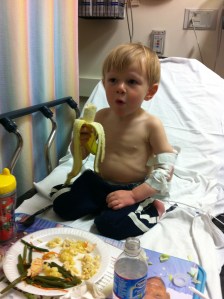
Jake in the ER, Chowing down after his first insulin shot
Health Champs and Nutrition Superheroes,
My post today is a personal one. This past week, we found out that my 2 year-old son has type 1 diabetes (the need-insulin-shots-for-the-rest-of-his-life kind). Despite our uber healthy diet topping the charts with veggies, fruits, beans, and whole grains, an autoimmune response to a virus or reason unknown caused my littlest dude’s immune system to attack the insulin-producing cells of his pancreas. When this happens, insulin (which is like the key that unlocks cells’ doors to allow glucose to get in and do its job) can no longer be produced, leaving excessive glucose floating around the bloodstream. A normal body’s pancreas produces just enough insulin to deal with whatever carbohydrate is or isn’t eaten–no thought, shot, or pill needed. The glucose gets into the cells, blood sugars are stable, and none of it requires any extra effort.
As type 1 diabetes is hitting, however, and the insulin-producing cells are being destroyed, the body panics with the extra glucose floating around the bloodstream and reacts by pulling fluid from every store to try and eliminate the glucose through the urine. Dehydration and extreme thirst result. Those are the first signs. The next are usually lethargy and vomiting.
About 5 days before we discovered Jake’s diabetes, he had been asking for more water and urinating more. Not crazy amounts, we just had to change his diaper more often. He was getting over a cold, so of course he was thirstier. He even had a fever one night and I took him to the pediatrician first thing the following morning suspecting an ear infection. But nothing was wrong. Well, once Day 5 hit and he was still asking for “wa wa please” every several minutes (and his grandma also noticed he was cold and his skin looked a little thin), I asked the nurses at my work if they thought anything of his excessive thirst, and asked if I might borrow a glucometer to test his blood sugar levels, just to rule out diabetes. They had seen this before and were worried. They encouraged me to postpone my patients for the day and go home to test his blood sugar, and then I could return if all was well.
His blood sugar level was 560 and then retested at 549. Normal is 100-200 for a 2 year-old. Obviously, it was a faulty machine. I tested MY levels: 73. Crap. Fast-forward past the ER at Children’s hospital, IV fluids to rehydrate him, the official diabetes diagnosis, and a daylong diabetes bootcamp with a diabetes educator to learn how to test blood sugars (I was very awkward in testing his levels at home!), give insulin shots, and manage his meals. All I kept thinking was thank gosh I have the nutrition stuff down because the insulin and blood sugar monitoring was about all the new learning our brains could take!
So, here we are now on Day 3 at home and are getting used to our new ways. We’ve only now realized how much more alive Jake is compared to last week. His body is happy, he laughs and jokes constantly, he’s gained nearly 3 lbs since getting insulin shots because his cells are finally getting the glucose they need, and he’s even telling us which finger to prick for each of his glucose checks. Our days consist of 4 insulin shots, several blood sugar checks to help detect low blood sugar levels (which can be serious)–including 2 while he’s sleeping. My husband and I sneak in there like a diabetes SWAT team with our headlamps and blood sugar checking gear. Most of the time, he sleeps right through! Blood sugar checks also determine what kind of snack he can have: low-carb if his blood sugars are within the normal range, and carby if his blood sugars are low. Our days no longer include enticing desserts to encourage veggie consumption at mealtime, and there are no more meals on the run. Meals MUST be balanced: moderate carbohydrates (about 30-40 grams per meal), protein, and fat. Carbohydrates turn into glucose in the bloodstream immediately, 40% of protein turns into glucose 1-2 hours after consumption, and 10% of fat turns into glucose about 4 hours after consumption. A balanced meal means blood glucose levels are less likely to drop too low between meals. We can do this!
Thanks to our previously healthy habits, the nutrition part of diabetes management is pretty much the same, and any changes have been for the better (we WERE probably getting a little too crazy with the desserts…). Today for lunch, we all had hummus (some carb, some protein, some fat), broccoli (a “free” and healthy food), whole wheat crackers (only a few, so Jake also had a banana to meet his carbohydrate needs), avocado slices (fat), and ice water. The morning snack which would have been pretzels, became a naturally low-carb peanut butter spoon, one of Jake’s all-time favorite treats. We’re all having to change some–We, and my other 2 kids can’t be chowing on foods that Jake can’t have (like pretzels at snacktime) until Jake understands what’s going on. But we’re realizing that his diet is actually just a balanced one that leaves the junk behind. We’ll all be even healthier now!
Obviously, this new life is no walk in the park, and my anti-carb-counting and anti-low-carb days are over. I appreciate both now. But, we are so blessed to have this super cool kid, who can still be a kid and live a healthy, normal life. We’re finding that type 1 diabetes isn’t hard, it’s just more. More to watch and do. So we’ll probably just put off getting that puppy for now… 🙂
Even a dietitian’s child gets diabetes, and even a dietitian’s family can improve their eating habits. Stay tuned for a new tab: Bitchin’ Diabetes! And please share stories and tips.
Peace and balance,
xoxoxo
Jen






 Delish & Healthy-ish With Jen Reilly, RD